Aviation & Aerospace
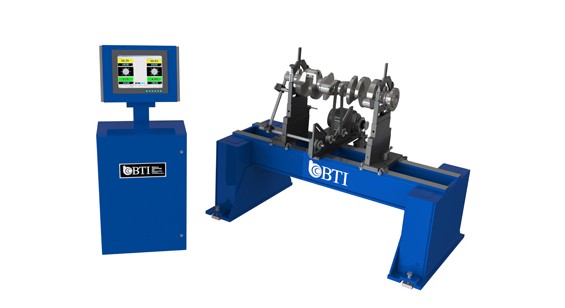
In aviation and aerospace, unbalance is a flight-safety issue before it is a quality issue. Balance Technology Inc. designs and builds balancing machines, spin test equipment, and precision measurement systems for turbine engine components, rotating airframe hardware, and propulsion assemblies — supporting both OEM production lines and MRO (maintenance, repair, and overhaul) operations.
Every BTI machine is configured-to-order from a proven platform. We begin with your part drawing, your balance specification, and your required cycle time, then configure the tooling, drive system, correction method, and controls around them. Your rotor never has to be made to fit a fixed catalog model.
Aerospace Components We Balance
BTI has built balancing and spin test solutions for the full range of gas turbine and rotorcraft rotating hardware, including:
- High pressure turbines (HPT)
- Low pressure turbines (LPT)
- High pressure shafts
- Low pressure shafts
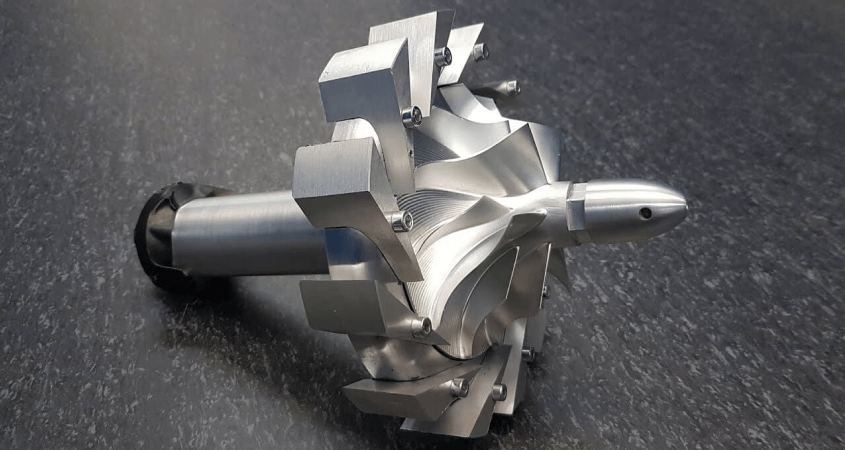
- Blades and blisks
- Nose cones
- Full stack and complete assembly balancing
- Propellers and helicopter blades
- Auxiliary power units (APUs)
- Aircraft wheels and tires
If your component is not on this list, it is still worth a conversation. Because every system is designed to the part, unusual geometry, unusual materials, and unusual balance requirements are the normal starting point for a BTI project rather than an exception to it.
Configured-to-Order Capability Range
Aerospace balancing spans an unusually wide envelope — a single engine program can involve a blade weighing well under a pound and a test fixture weighing many tons. BTI works across that whole range.
| Part weight | 0.5 lb to 200,000+ lb |
|---|---|
| Balancing speed | Low-speed through high-speed balancing |
| Balance grade | Driven by the customer part design, not by a fixed machine class |
| Correction methods | Drill, mill, grind, and weld correction, plus mass-add methods |
| Automation level | Manual, semi-automatic, and fully automatic multi-station systems |
| Delivery model | Configured-to-order; new machines, rebuilds, retrofits, and control upgrades |
Balance Standards and Certification
BTI certifies machines to ISO 21940 (mechanical vibration — rotor balancing), to SAE International balancing specifications, and to DIN specifications. Which standard governs, and to what grade, is determined by your part design and your program requirements; we build the acceptance criteria and the certification path into the machine specification up front rather than treating it as a post-delivery exercise.
For programs with formal qualification requirements, balance grade verification, master rotor traceability, and repeatability studies are defined as part of the factory acceptance test.
Spin Testing
BTI offers spin testing at our Whitmore Lake, Michigan facility and also builds spin test equipment for customer sites. Spin testing complements balancing on aerospace programs: balancing establishes that mass distribution is within grade, while spin testing demonstrates how the rotor actually behaves through its speed range — growth, deflection, and stability at operating and overspeed conditions.
Combining both operations in one cell, or in one machine, shortens the qualification loop for turbine rotors and assemblies and removes a handling step on flight-critical hardware.
OEM Production and MRO
The two sides of aerospace balancing pull machine design in different directions, and BTI builds for both.
OEM production work is driven by takt time and repeatability: fixed part families, automated load and unload, in-process correction, and data collection tied to the part serial number. MRO work is driven by variety: a shop may see several engine models and many part numbers on the same machine, so tooling changeover, operator guidance, and recipe management matter more than raw cycle time.
We size the automation, the tooling strategy, and the software around whichever of these describes your operation — and on mixed sites, around both.
Aerospace Balancing Equipment and Applications
Aerospace programs at BTI usually draw on more than one part of our catalog. These pages go a level deeper:
- Turbine, jet engine, blade and propeller balancing applications — the application detail behind turbine engine work, including blade and blisk handling
- Balancing machines — the full range of BTI balancer types, drives, and correction methods
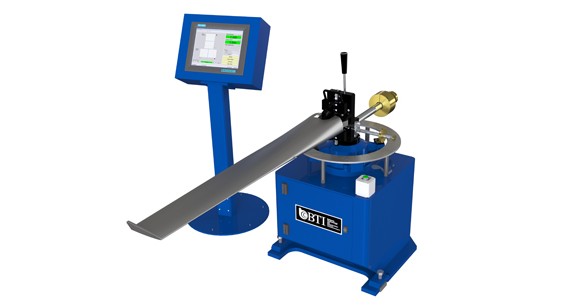
- Moment balancer for helicopter blades and propellers — moment balancing for rotorcraft and propeller blade sets
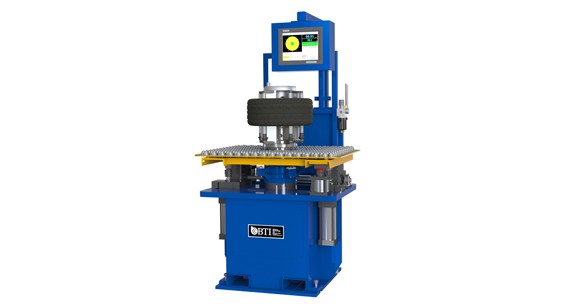
- Static aircraft tire balancer with load-assist elevator — aircraft wheel and tire balancing with operator load assist
- Rebuilds and retrofits — extending the life of existing aerospace balancing assets, including competitor machines
- Military and defense balancing — where aerospace work overlaps with defense program requirements
Balance Grade and Tolerance
Balance tolerances are set by ISO 21940-11, which superseded ISO 1940-1. The standard assigns a balance quality grade G, and the permissible residual specific unbalance follows from that grade and the service speed:
eper = (G × 60) ÷ (2π × n)
where eper is permissible residual specific unbalance in g·mm/kg, G is the balance quality grade in mm/s, and n is the service speed in rev/min. Permissible residual unbalance is then U = eper × m, divided across the correction planes.
| Grade | Typical components |
|---|---|
| G 2.5 | Gas and steam turbines, turbo-compressors, turbine-driven pumps |
| G 6.3 | Fans, pump impellers, process plant machines |
| G 1 | Small armatures with special requirements |
Engine programs commonly specify their own balance tolerance in the build manual rather than relying on the ISO category, and those tolerances are usually tighter. Where a drawing states a tolerance, that governs. Work out a specific figure with the ISO balance tolerance calculator.
Frequently Asked Questions
What balance grade does a turbine rotor need?
ISO 21940-11 places gas and steam turbines at G 2.5, but engine programs normally specify their own tolerance in the build manual, and it is usually tighter than the ISO category. Where the drawing states a tolerance, that is the one that governs.
How are blades and blisks balanced?
Blade sets are matched by moment, not by weight alone, because two blades of equal mass still produce a couple if that mass sits differently along the radius. BTI builds moment balancers for blades and propellers. A blisk is balanced as a single rotor, since the blades cannot be redistributed.
Can BTI support both OEM production and MRO?
Yes, and they are different machines. Production programs are engineered from the part print around one part family. Overhaul shops are better served by a standard model sized for the heaviest rotor in their range.
Does BTI offer spin testing?
Yes, both as BTI-built spin test stands and spinners, and as a service.
Does BTI rebuild or retrofit existing balancing machines?
Yes, including machines built by other manufacturers. See BTI rebuilds and retrofits, competitor rebuilds and retrofits, and PC upgrades.
What information does BTI need to quote?
The part print, the part weight, the service speed, the balance tolerance if one is specified, and the required production rate.
Talk to an Application Engineer
Aerospace balancing questions are rarely answered from a datasheet. If you can share the part, the balance specification, and the throughput you need, a BTI application engineer can tell you what the machine looks like — and whether balancing, spin testing, or both belong in the cell.
Contact BTI to start an aerospace balancing or spin test discussion.









Connect with us
To contact us regarding your project - or if you have any questions - please click the button below :
Request a QuoteGet Started
Get in touch with us. We're here to assist you.
Connect with our measurement experts and get the technical guidance your application demands.