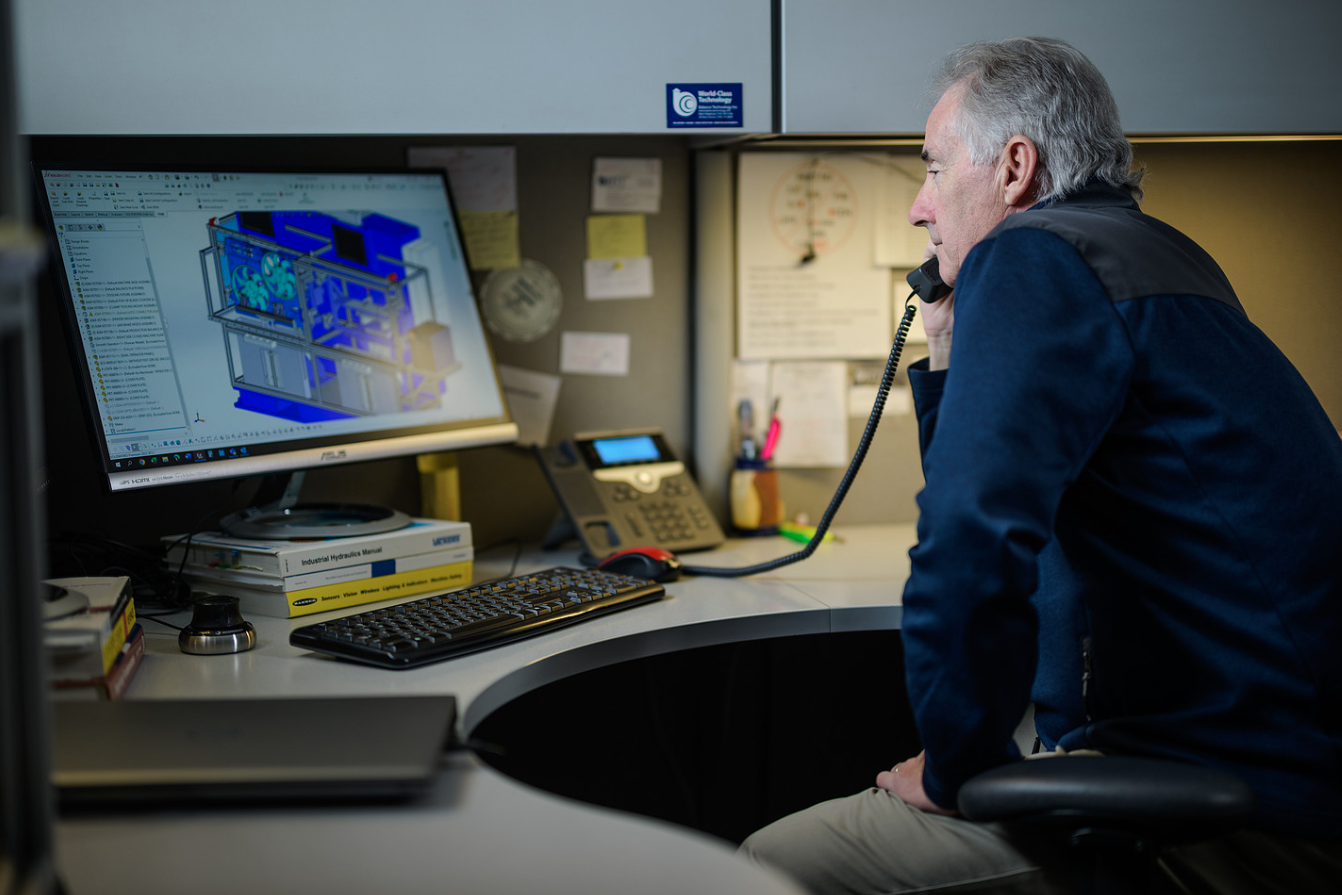
Configured to your part. Proven 14,000 times. BTI is a configured-to-order builder. Every machine starts from one of the four platforms on this page, designs we have already built and supported, and is configured to your part: class, tooling, fixtures, measurement and automation. More than 14,000 machines and systems have shipped to more than 25 countries. When a job needs new design, our engineers handle that too.
Balance Technology has built balancing and measurement machines since 1968 — for engine plants running a part every twenty seconds, and for repair shops that see a different part number every morning. Both get a machine from the same four platform families, built on the same measurement core, supported by the same people.
What changes between them is not the quality of the machine. It is the class, the configuration, and how tightly the system has to be qualified.
Two Questions Decide Almost Everything
- What does the part weigh? That, plus the tooling to hold it, sets the platform class.
- What do you need to prove? That sets how precisely the class has to be matched, and what we qualify before shipment.
Answer those two and we can name a platform and class. Most of the time we can do that the same day.
The Four Platforms
| Code | Platform | Typical use |
|---|---|---|
| VNR | Vertical Non-Rotator | Static balancing of discs, wheels, plates and tires — parts measured without spinning |
| VR | Vertical Rotator | Dynamic balancing of discs, rotors, impellers and flanges on a vertical spindle |
| H | Horizontal Cradle | Shafts, crankshafts, driveshafts, armatures and turbine rotors — parts carried between supports |
| P | Platform Suspension | Assemblies that bring their own bearings — fan modules, motor assemblies, turbocharger cores |
Alongside these sit tool holder balancers (THB), vertical and functional test stands (VTS, FTS) and test spinners (TS).
Each platform is offered in a ladder of classes. The class is not a part weight — it describes the size and load envelope of the base itself.
Why We Will Not Publish a Capacity Chart
Most balancing machine catalogues list a maximum part weight per model. We do not, because that number is not knowable from the part alone.
A platform class has to carry the tooling plus the part. The tooling is what locates and clamps your specific component, and it is not designed until we have reviewed your part prints and concepted it. Until then, nobody — including us — knows the real load.
The second reason matters more. The heavier the tooling-and-part assembly is relative to the class, the less repeatable and accurate the machine becomes. There is no hard cutoff where a machine stops working. There is a gradient where it becomes progressively less able to resolve small unbalance.
So a published capacity figure would be wrong in both directions at once. It would turn away a repair shop that could run a much heavier part perfectly well for its purposes, and it would mislead a production engineer into expecting a qualification result the ratio cannot support.
What we do instead is size the class to your actual tooling-and-part weight, and tell you what that ratio will hold.
The Same Platform, Two Honest Answers
Take a class-50 vertical rotator. Two customers can buy that machine and both be right.
When it needs to work
MRO, remanufacturing, aftermarket and job shops. Mixed part numbers, no balancing engineer on staff, and a machine bought because something stopped this week.
Here the platform runs wide. A single class can cover a broad span of part weights, accepting that resolution falls off as the load rises — which for this work is usually irrelevant. The part needs to come out smoother than it went in, verifiably, at a price and a lead time the shop can live with.
Tell us what the part weighs. We will name a platform and class the same day, and quote it with a firm lead time.
When it needs to be proven
OEM programs, Tier 1 suppliers, aerospace and defense. Fixed part families, formal capability requirements, and a measurement system that has to be defensible to a customer audit.
Here the class is matched tightly to the tooling-and-part weight, because the ratio directly governs the capability study. Correction method, drive, gaging and automation are specified around takt time, and acceptance criteria are written into the specification before the machine is designed.
Send the part prints and the balance specification. We will concept the tooling, size the class to it, and tell you what the system will hold before you order.
Measurement System Capability
On qualification-driven programs the machine has to satisfy a capability study, not just a balance tolerance. Which study applies, and what level it has to reach, varies by program — and so does whether a given part can reach it.
Capability is a property of the whole system, not of the machine alone. It depends on the balance tolerance itself, on how repeatably your component locates in the tooling, and on the part’s own construction. Assemblies that bring their own spindle and bearings behave differently from a rotor mounted on ours, and on some of those a representative master part is itself difficult to produce.
For that reason BTI does not publish a blanket capability figure. Where a program carries a capability requirement, we evaluate the part and the process first, then confirm what is achievable and commit to it in the machine specification. A number agreed before anyone has looked at the part is not a commitment, it is a guess with a signature on it.
That evaluation is what BTI’s Measurement & Testing division exists to do. Send the component, or send data that accurately represents it, and we will tell you what the system can hold before a machine is designed around it.
How a Machine Is Specified
Platform and class set the base. Everything after that is a configuration decision:
- Control type — manual, semi-automatic (operator loads and unloads), or fully automatic
- Correction method — drill, mill, grind, punch, rivet, weld, sander, tape, or weight addition
- Drive type — belt, end drive, air driven, or air bearing
- Measurement add-ons — dimensional gaging, eddy current crack detection, surface finish, natural frequency, NVH, leak test, laser marking, sorting, oil fill
A designation such as VR-50SA-CM-DG reads as a class-50 vertical rotator, semi-automatic, with correction mill and dimensional gaging. The same base without those modifiers is a considerably simpler and less expensive machine — and for a great many shops, the right one.
This Is Not a New Catalogue
Every machine in our delivered archive is one of these platforms, configured. Browsing it is the fastest way to see what a platform becomes in practice — the same VR base appearing as a bare measuring station in one plant and a five-station automated cell in another.
- Balancing machines — the full range of BTI balancer types, drives and correction methods
- Combination equipment — platforms carrying gaging, crack detection, test and marking in one station
- Rebuilds and retrofits — extending the life of an existing platform, including competitor machines
- Measurement & Testing services — characterizing your part before a machine is designed
Talk to an Application Engineer
Two questions get this moving: what the part weighs, and what you need to prove. With those, a BTI application engineer can name the platform and class — usually the same day.
Contact BTI to size a machine to your part.