
HVAC
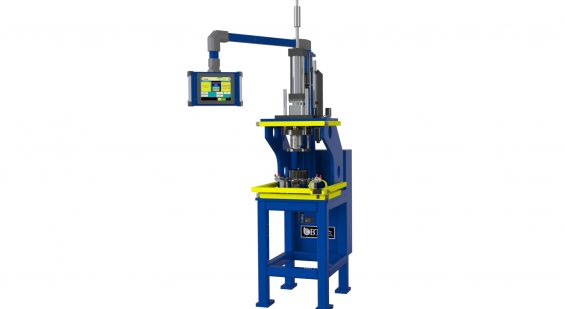
BTI builds balancing systems for HVAC manufacturing: fan wheels, blower assemblies, motor-fan modules and complete air handling units. HVAC is a noise business as much as an airflow business: the residual unbalance a plant accepts on the line is what the building owner hears for the life of the unit.What BTI Balances in HVAC
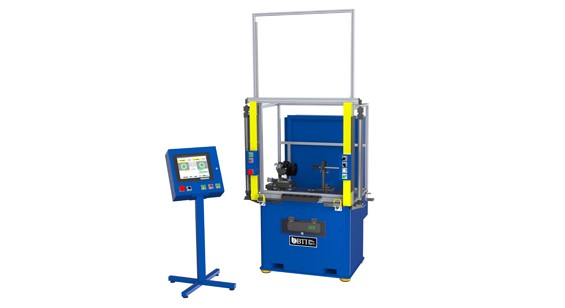
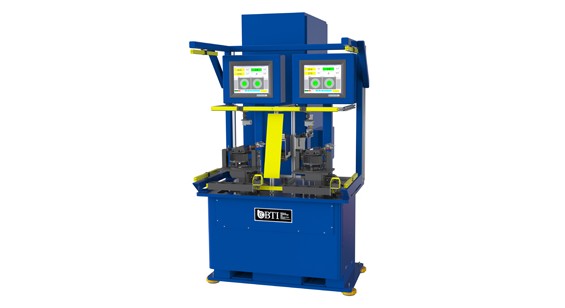
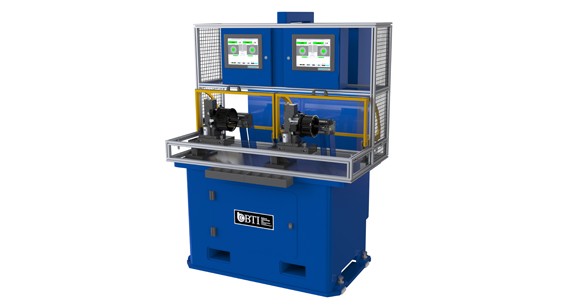
BTI balancing machines are built on four platforms (VNR (vertical non-rotator), H (horizontal cradle), VR (vertical rotator) and P (platform suspension)) plus tool holder balancers, spinners and test stands. The platform follows the part geometry and how it has to be held; the correction method follows the material and where there is room to add or remove mass.| Component | Typical platform | Correction method |
|---|---|---|
| Centrifugal fan wheels (squirrel cage) | H, P, VNR | Clip-on weight |
| Axial fan blades and hubs | VNR, VR | Weight-add |
| Blower and scroll assemblies | P | Weight-add, adhesive |
| Motor-fan modules | P | Weight-add |
| Motor rotors and armatures | H | Mill, drill |
How a Machine Gets Sized
A BTI machine designation names a platform and a class. A P-5 is the platform suspension base, class 5. The number is a class, not a part weight limit: it describes the size and load envelope of the base. Sizing works from the tooling and the part together, not the part alone. Tooling is not specified until the part prints are reviewed and the fixture is concepted, and the heavier the tooling-plus-part assembly is relative to the class, the less repeatable the measurement becomes. A shop that needs one machine to cover a wide range of parts, and does not need tight repeatability, can run a much broader weight range on a given class than a production program can. Tell BTI the part weight and BTI will name a class the same day. See BTI machine platforms for the full platform and class architecture.Balance Grade and Tolerance
Balance tolerances are set by ISO 21940-11, which superseded ISO 1940-1. The standard assigns a balance quality grade G, and the permissible residual specific unbalance follows from that grade and the service speed: eper = (G × 60) ÷ (2π × n) where eper is permissible residual specific unbalance in g·mm/kg, G is the balance quality grade in mm/s, and n is the service speed in rev/min. Permissible residual unbalance is then U = eper × m, divided across the correction planes.| Grade | Typical components |
|---|---|
| G 6.3 | Fans, pump impellers, normal electric armatures |
| G 2.5 | Medium and large electric armatures with special requirements |
Balancing for Sound, Not Only for Bearings
Most balance specifications exist to protect bearings. In HVAC the binding constraint is usually acoustic: an assembly can sit well inside its bearing-life tolerance and still produce a tone the occupant notices. That is why HVAC lines pair balancing with sound and vibration measurement on the same station, and why BTI measures the module as assembled, with its shroud, rather than the bare wheel.Correction Methods
| Method | Where it fits |
|---|---|
| Drill | Cast and forged parts with material available to remove |
| Mill | Controlled removal on a defined correction band |
| Grind | Hardened or finished surfaces |
| Weld-on weight | Shafts and assemblies, adding rather than removing mass |
| Clip-on or press-on weight | Wheels, fan wheels and rims |
| Adhesive and applied weight | Modules, plastics and assemblies |
Standards
BTI certifies machines to ISO 21940, SAE International balancing specifications, and DIN specifications. Where a program carries a measurement system capability requirement, BTI evaluates the part and the process first, then confirms what is achievable and commits to it in the machine specification.Frequently Asked Questions
Should a fan be balanced bare or as an assembly?
As the assembly it ships as. A bare wheel balanced to grade can fall out of tolerance once it is mounted to its motor and shroud, because the assembly introduces its own unbalance and its own running geometry.
Can one machine handle both fan wheels and complete modules?
Within a class, yes. Module work usually runs on a platform suspension base with a wind shroud, so the fan can be measured at service speed without airflow disturbing the reading.
Does BTI rebuild or retrofit existing balancing machines?
Yes, including machines built by other manufacturers. See BTI rebuilds and retrofits, competitor rebuilds and retrofits, and PC upgrades.
How are BTI lead times quoted?
Lead times are quoted in weeks at the time of quotation. They move with current backlog, so BTI confirms the schedule for a specific machine as part of the quote rather than publishing a fixed figure.
What information does BTI need to quote?
The part print, the part weight, the service speed, the balance tolerance if one is specified, and the required production rate.
Related applications: HVAC assemblies, pumps, fans, impellers and blowers, armatures, rotors and motor assemblies, engine cooling modules. Related equipment: NVH and specialized testers.











Connect with us
To contact us regarding your project - or if you have any questions - please click the button below :
Request a QuoteGet Started
Get in touch with us. We're here to assist you.
Connect with our measurement experts and get the technical guidance your application demands.